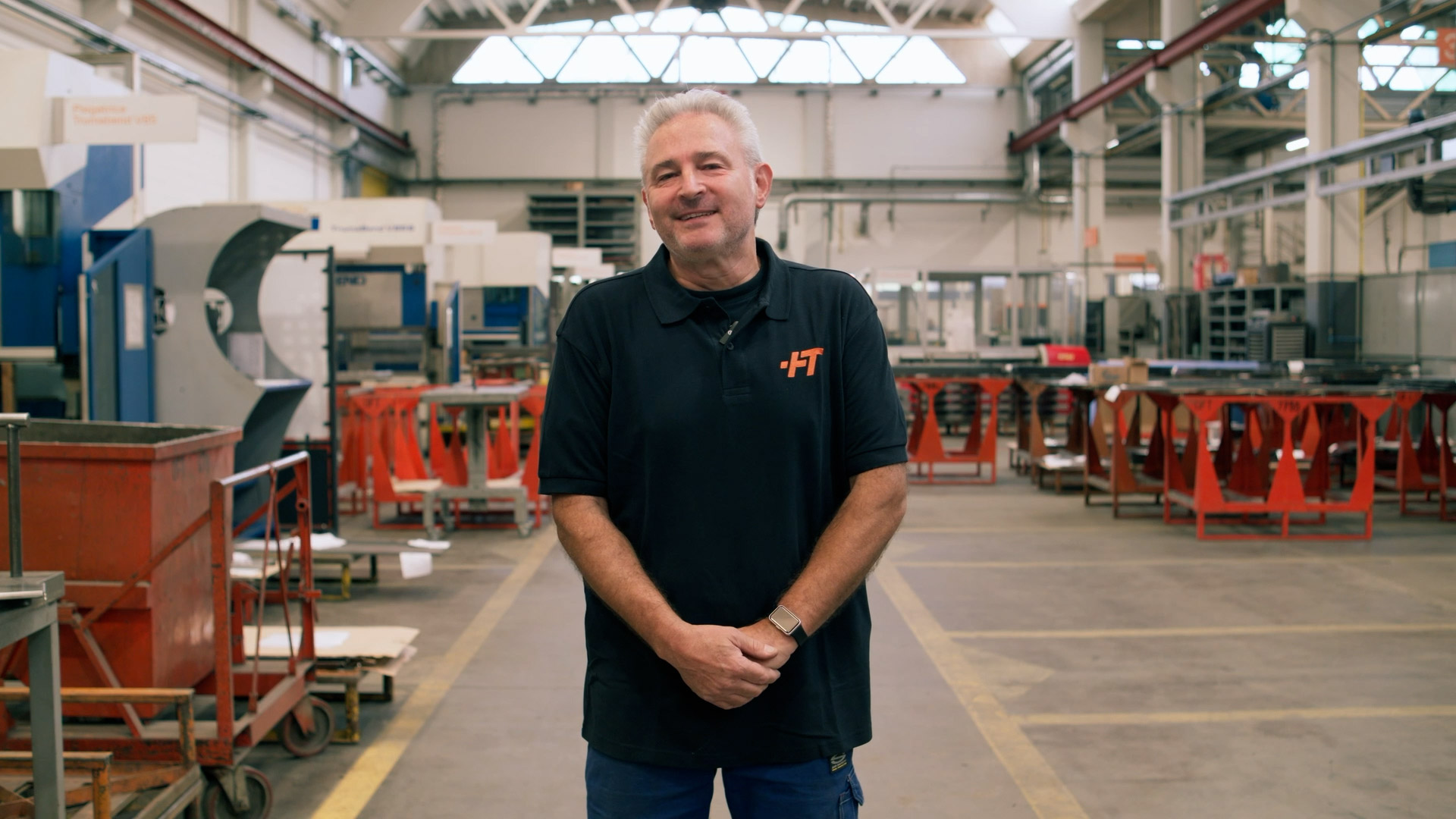
Putting experience to work
Some jobs are straightforward, while others require you to stop and think. For Paolo Foresti, Bending Department Manager, this is where creativity comes in. It means finding a practical way to make a part, while also looking to reduce the number of operations and the time involved.
‘Experience counts for a great deal when you’re developing a project,’ he explains. Those who have faced similar situations before can identify a possible approach more quickly and work out which solution to use.
Discussions with the designers help establish whether a part can be made as planned. Paolo draws on the expertise he has gained in the department to help assess what can be achieved with the available tooling and work through possible alternatives together.
This is where one person’s experience becomes valuable to others. A reasoned answer helps the designers understand how to proceed and involves the team in finding a solution.
Quality and trust at work
The conversation then turns to the team he leads. Paolo links quality to the responsibility of being someone his colleagues can trust. ‘First of all, you have to be credible,’ he says. This shapes his relationships with colleagues.
If something is done incorrectly, you need to step in and explain the mistake. When work is done well, using the right method and meeting the required standard of quality, it is just as important to acknowledge it, because work done well deserves attention too.
In both cases, the person leading the department is responsible for making it clear what is expected. Explaining a correction helps people understand those expectations better, while recognising a good result acknowledges the effort of the person who achieved it.
This relationship requires knowing each person’s personality and finding the right way to talk to them. Paolo says he feels fortunate because he is very happy with his team. He describes how that concern for people extends beyond departmental matters, to conversations about life outside work and any difficulties a colleague may be facing.
For Paolo, being responsible for a team means expecting quality work and taking an interest in the people who do it.
A company of families
Asked what it means to be part of a family business, Paolo replies that, for him, Taiocchi is a ‘company of families’. As well as the owners’ family, there are the families of the people who work at the company. His brother and two nephews work with him.
He has always seen having family at the company as a strength. Speaking about his connection with Taiocchi, he returns to the importance of personal relationships, which have always been a positive part of his experience there. The atmosphere at the company comes through in his everyday experience and his ties with the people who work there.
A tradition among colleagues
The conversation ends with a long-standing custom. When someone at the company has a birthday, cakes and tarts are brought in to share with colleagues.
Paolo says it all began five or six years ago, when a colleague suggested replacing the pastries with cakes. The idea caught on, and several colleagues now turn to him for their own birthday cakes.
The cakes, he explains, are made by his wife. ‘They’re good, and everyone’s happy.’


